Why Do You Feel Heat and Tingling During Reiki?
Here's the pattern that shows up in nearly every Reiki session that begins with skepticism and ends with confusion: someone lies down expecting either transcendent peace or theatrical light shows…
Jeffrey Conroy·Updated: September 06, 2026·9 min read
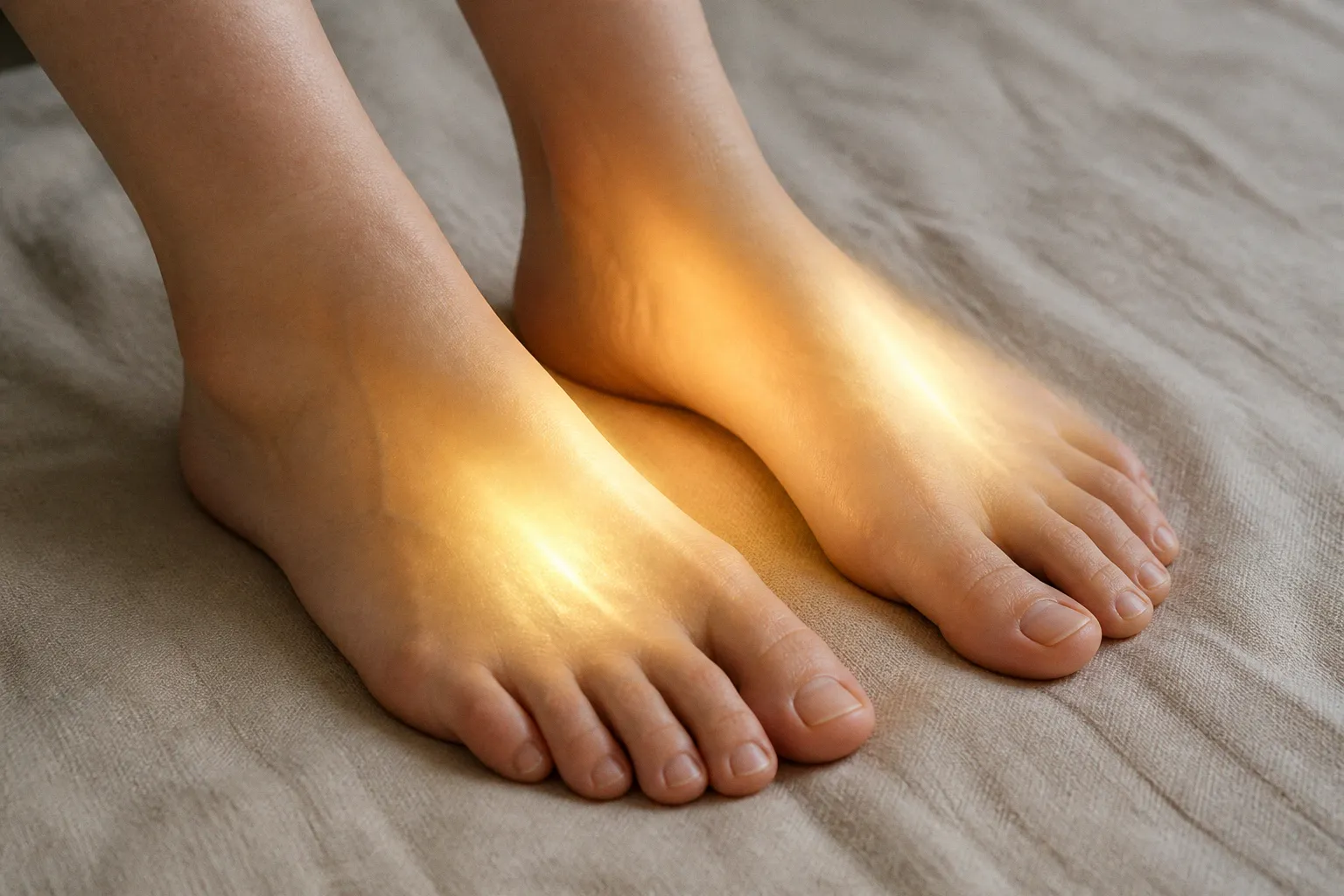
Here's the pattern that shows up in nearly every Reiki session that begins with skepticism and ends with confusion: someone lies down expecting either transcendent peace or theatrical light shows, feels a mild warmth in their palms or a faint pins-and-needles in their chest, and walks away trying to decode whether the practitioner is legitimate, whether they're placeboing themselves, or whether the whole modality is just expensive hand-waving. None of those three framings survive contact with what actually happens during a session. They're all category errors.
Heat and tingling are the two most reported physical sensations during Reiki work — and they show up during hands-off sessions too, where the practitioner's hands never touch the body. That single detail collapses most of the skeptical objections and most of the magical-thinking objections in the same breath. Something is shifting in the recipient's nervous system and tissue. The interesting question is what.
Sensation isn't proof the energy is real. Sensation is proof the nervous system is shifting state.
The Energetic Perspective: Byosen and the Flow of Ki
Traditional Usui Reiki, the lineage Mikao Usui formalized in Japan in the early 1920s — the Usui Reiki Ryoho Gakkai was established in 1922, four years before his death in 1926 — explains these sensations through a specific mechanism called Byosen. In this framework, tingling in the practitioner's hands isn't random nerve misfiring. It's described as the radiation of energetic imbalance or blockage in the recipient's body. The practitioner feels where the client's Ki, or universal life force energy, is congested. The heat and tingling the recipient feels is the reciprocal signal: their own energy beginning to move through an area that was previously stuck.
Two details make this framework hard to dismiss without engaging with it. First, it predates most modern energy medicine terminology and has been internally consistent for roughly a century. Second, it generates testable predictions — practitioners trained in Byosen are taught to scan for these sensations in specific anatomical regions, and those regions correspond to the seven main chakras, which physically align with major endocrine glands and lymphatic system organs along the body's midline.
The cost of treating this as mystical nonsense is that you lose the diagnostic layer it provides. The cost of treating it as literal physics is that you overcommit to a metaphor. The productive move is to hold both: the sensations are real, the framework for interpreting them is useful, and the framework doesn't have to be the final word.
Physiological Drivers: Nervous System Activation and Vasodilation
Here's where the systems-oriented reading kicks in. A typical Reiki session runs 45 to 60 minutes, and the conditions it creates are nearly impossible to reproduce through ordinary waking relaxation. The recipient is supine, eyes usually closed, in a quiet room, often with attention drawn systematically through body regions. This is a textbook setup for parasympathetic nervous system activation: the rest-and-digest branch of the autonomic system, the opposite of fight-or-flight.
When the parasympathetic system takes over, three things happen in sequence:
- Skeletal muscle tension drops. The fascia, which has been holding a low-grade defensive posture since the last cortisol spike, starts to release.
- Blood vessels dilate, especially in peripheral tissue. This is vasodilation — capillaries that were constricted open up, and blood flow to the skin and extremities increases.
- Microcirculation picks up. Local tissue perfusion, the slow exchange of oxygen and metabolic waste at the capillary level, increases measurably.
That last item is where the heat comes from, and it's not controversial. It's perfusion. When blood flow to a region increases, the tissue warms up. When the practitioner's hands are hovering near the recipient's skin, the recipient feels it as radiant warmth. When the practitioner's own hands are doing the work, the practitioner feels it too — usually as a subtle heat or pulse in their palms, especially if they're trained to scan for it. The tingling is the sensory cortex registering micro-changes in skin temperature, light pressure differential, and small involuntary muscle twitches as the body drops out of its default state of guarded tension.
The clean summary: heat and tingling during Reiki are reliable signs of nervous system downregulation, not supernatural transmission. That's not a debunking. That's a mechanism. And it sits comfortably next to the Byosen reading without contradiction.
The session that feels like nothing isn't a broken session. It's a session where the nervous system did its work below the floor of conscious perception.
Interpreting Temperature: Understanding Yin and Yang in Energy Work
Energy medicine frameworks rooted in traditional Chinese philosophy add a second interpretive layer on top of the physiological one. Yin and Yang, in this context, aren't philosophical abstractions. They're diagnostic categories applied to the client's energetic state, and the practitioner's hands are the sensor array.
| Reading | Practitioner Hand Temperature | Client State |
|---|---|---|
| Excess Yang | Hot | Inflammation, acute stress, sympathetic overdrive |
| Excess Yin | Cold | Depletion, exhaustion, sluggish circulation, low reserves |
This is where the systems language earns its keep. The practitioner isn't generating the heat or the cold. They're functioning as a thermal sensor, reading the client's state through the temperature differential in their own hands. It's the same logic as a thermostat, except the practitioner is the thermostat and the client is the room.
The skeptical reader will note, correctly, that hand temperature is influenced by the practitioner's own circulatory state, hydration, stress level, and the ambient room temperature. That's a fair complication. The serious practitioner accounts for it. The unserious one doesn't, and produces inconsistent readings. Temperature interpretation in Reiki is a skill, not a birthright — and like any skill, it has a calibration curve. The leverage is real, but only for practitioners who treat it as a discipline.
The Spectrum of Therapeutic Sensations Beyond Heat
Heat and tingling get the attention because they're dramatic. They're not the whole catalog. A narrative review published through PubMed Central, looking across biofield therapy, acupuncture, hypnotherapy, and qigong, grouped a broader cluster of physical responses under a single heading: therapeutic sensations. The full list includes warmth, tingling, dull pain, heaviness, and a few others — and crucially, the review found that these same sensations show up across modalities that have nothing technically in common.
That's a useful data point, and it cuts both ways. If warmth and tingling reliably appear during acupuncture (a needle-based intervention with no sustained hand contact), during hypnotherapy (no body contact at all), during qigong (movement-based self-practice), and during Reiki, then the sensations can't be the unique signature of any one modality's mechanism. They're what the body does when a sufficiently deep relaxation-and-attention state is induced, regardless of the method used to induce it.
This doesn't trivialize Reiki. It contextualizes it. The modality isn't special because it produces tingling. It's special because the framework it provides — the four levels of Usui Reiki training, the specific hand placements along the chakra-endocrine-lymphatic axis, the Byosen diagnostic layer — gives the recipient and practitioner a vocabulary for what the body is doing, and a structured protocol for doing it consistently.
The seven main chakras, which anchor most standard Usui Reiki hand placements, are useful here as anatomical anchors rather than mystical symbols. They map onto the seven major endocrine glands and align roughly with major lymphatic drainage regions. A practitioner working through the chakra sequence isn't wandering. They're systematically sweeping through the systems most involved in stress response, immune function, and emotional regulation.
Why Feeling Nothing Is Just as Valid as Feeling Everything
Now the part that breaks most beginners and most skeptics in the same way: some people feel nothing during a Reiki session. No heat. No tingling. No heaviness, no lightness, no emotional release, no visionary experience. They lie there for the full 45 to 60 minutes and walk out wondering if they wasted their time.
According to the Usui tradition, according to experienced practitioners across all four training levels, and according to the physiological model, this is normal. It's not evidence of a failed session. It's not evidence of an incompetent practitioner. It's not evidence that the modality is empty. It's evidence that the recipient's nervous system doesn't generate the same sensory signals during deep relaxation that someone else's does, or that the signals are below conscious threshold, or that the recipient is too cognitively active during the session for the parasympathetic shift to register as a sensation.
The trap is the assumption that intensity equals efficacy. That's the same error people make with massage: a hard deep-tissue session must be more effective than a gentle one. Sometimes. Not always. Pressure is not the variable. Outcome is the variable. And in the published research, no direct correlation has been established between how strongly a recipient feels sensations during a Reiki session and how much clinical benefit they report afterward. Whether sensation intensity maps onto therapeutic outcome magnitude remains an open question — and treating it as settled is exactly the kind of premature certainty that wastes bandwidth.
What this means practically: stop grading your session by how warm your palms got. The session is doing what it's doing whether you felt it or not. The metric worth tracking is whether your baseline state shifted in the 24 to 48 hours after — sleep quality, anxiety frequency, the duration of a typical stress response. That's the signal. Everything else is commentary.
So what's the actual diagnostic worth running here, before your next session or before you write off the modality entirely? Ask three questions, and answer honestly.
1. Did your baseline stress markers change in the 48 hours after the session — sleep, reactivity, resting heart rate, whatever you're tracking?
2. Are you evaluating the session in real time, when the body is still in the middle of the shift, or are you giving it two days to land?
3. Did you show up to the session in a state where you were actually willing to downregulate, or were you lying there with your analytical mind running diagnostics on the practitioner?
If the answer to the first two is yes, materially, and the answer to the third is no, not really — the modality works. Your assessment protocol is the variable that needs fixing, not the practitioner and not the tradition.
Heat and tingling during Reiki are reliable, reproducible, and explainable through both energetic and physiological models. They are not, however, the unit of measurement for whether anything happened. They're a side effect of something deeper — a nervous system finally being given permission to drop out of its default state, with a structured framework guiding that drop. Whether you feel that drop consciously or not, the drop is the event. Everything else is the body telling you it noticed.