What Happens During a Clinical Hypnotherapy Session?
Most people walk into a first hypnosis appointment expecting one of two things: a swinging pocket watch and a theatrical "you are getting sleepy," or something so abstract and woo-tinged that it might as well be a scented candle ceremony.
Jeffrey Conroy·Updated: September 05, 2026·7 min read
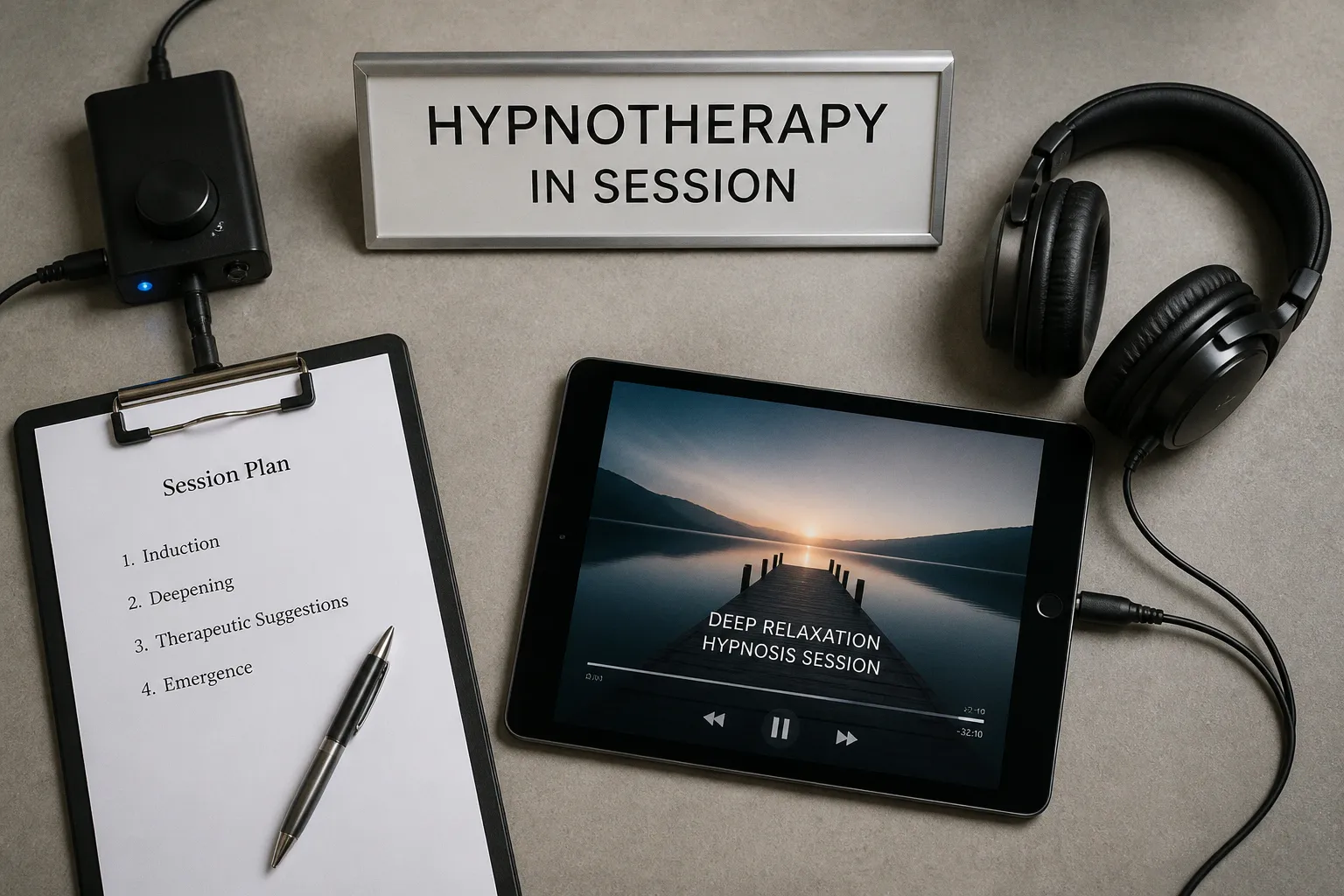
Both frames are wrong, and both set the client up to waste sessions. Hypnotherapy is not a performance. It is a structured, four-stage protocol designed to shift your brain out of its default analytical mode and into a state where targeted suggestions can actually land. If you don't understand the architecture, you'll judge the work by the wrong metrics and bail before the leverage kicks in.
Here's the mechanism in plain terms, stage by stage, and exactly what your brain is doing while the therapist talks.
The Pre-Talk: Establishing Goals and Collaborative Intent
Before anyone closes their eyes, there's a working conversation. This is the part most clients underweight because it doesn't feel like the "real" hypnosis. That's a category error.
The pre-talk is where the therapist maps the problem onto a specific, measurable target. Not "feel better about food." Not "reduce stress." Those are slogans. The pre-talk forces language like: "When I notice the urge to snack after 9 p.m., I will pause, name the trigger, and use the rehearsed alternative behavior for sixty seconds." If your therapist cannot translate your goal into that kind of operational language, the session has no leverage to generate.
A vague goal is a session that runs on fumes. The pre-talk is where the fuel gets loaded.
Expect a short intake on history, current symptoms, contraindications, and what you've already tried. Expect direct questions. Expect to be treated like a peer in a design conversation, not a supplicant on a couch. The therapist's job in this phase is to identify the friction points — the specific moments, contexts, or automatic thoughts where your default behavior hijacks the outcome you're claiming to want. Once those are named, the rest of the session has something to aim at.
If your therapist skips this stage or rushes it with generic language ("we'll work on your subconscious"), that is a signal. Walk, or at minimum, push back.
Induction and Deepening: Shifting from Beta to Theta Brain Waves
This is where the actual trance work begins, and it is less dramatic than the name suggests.
Induction is a guided shift of attention. Breathing slows. The therapist's voice becomes the primary input. Your brainwave activity moves from the analytical beta state — the one you're running while reading this sentence — into the slower alpha range, and for deeper work, theta. These are not mystical states. They are measurable neurological states associated with relaxed focus, reduced critical filtering, and heightened receptivity to imagery and suggestion.
You remain fully awake. You remain in control. You are not asleep, you have not surrendered your will, and you are not about to cluck like a chicken. Anyone promising you a stage-show version of hypnosis is selling a different product, and clinical literature is clear on this.
The deepening phase follows. If induction gets you to the door, deepening walks you down the hallway. Therapists use progressive muscular relaxation, counted breaths, guided imagery (a staircase, a descent, a slow walk through a familiar space), or rhythmic language patterns — all of which nudge brain activity further into theta territory. The point is bandwidth: in beta, your conscious mind is filtering most incoming input against your existing belief architecture. In theta, that filter loosens, and new patterns have a better chance of being encoded.
This is also the longest part of most sessions. Expect 10 to 40 minutes of steady, low-arousal focus once induction lands. If your therapist rushes through induction in three minutes to "get to the suggestions," they are skipping the leverage point.
Therapeutic Suggestions: Targeted Work in a Receptive State
Now the work happens.
In this receptive state, the therapist introduces the targeted suggestions that were framed during the pre-talk. The delivery is rarely a single dramatic command. It is layered: repetition, metaphor, reframing, and rehearsal of the new behavior in vivid sensory detail. For a client working on pain management, that might mean guided imagery of cool water moving through the affected area, paired with language that reframes the sensation as information rather than threat. For a client targeting anxiety, it could mean rehearsing a calm response in a previously charged scenario, with enough sensory granularity that the brain begins treating the rehearsal as a familiar pattern.
Hypnosis is not a magic wand dropped on the unconscious. It is rehearsal under conditions where the brain is more willing to update its model.
This is also where the therapist's training shows. Ericksonian approaches use indirect, permissive language — "you may notice yourself feeling…" — to reduce resistance. More direct clinical approaches use firmer framing. The right choice depends on the client and the goal. A practitioner who only uses one style is a specialist with a hammer.
The session's actual therapeutic payload lives here. The induction just gets you into the room. The suggestions are the work.
The Emergence Process: Returning to Full Alertness
Emergence is the exit ramp, and it matters more than most clients realize.
After the therapeutic phase, the therapist guides you back to full waking alertness, usually through gentle verbal cues, counting upwards, or a structured refocus on the room. This is not optional and it is not a formality. A clean emergence restores the brainwave pattern from alpha or theta back to beta, re-engages the analytical filter, and leaves the client grounded rather than foggy.
Most practitioners treat this as a 3 to 5 minute transition. Done well, you come out feeling focused, slightly quiet, and physically relaxed — not disoriented, not groggy, not emotionally raw. If you regularly finish a session feeling worse than when you started, that's data. Bring it up. Either the deepening was too shallow, the emergence was mishandled, or the therapeutic suggestions missed their target.
A short post-session debrief follows emergence. The therapist will often ask what you noticed, what felt vivid, and what you remember. This is not small talk. It calibrates the next session.
Debunking Myths: Consciousness, Control, and Safety
The mythology around hypnosis does more damage to clinical outcomes than almost any other factor. Let's retire the worst of it.
| Claim | What's actually happening |
|---|---|
| You lose consciousness during hypnosis | You remain fully aware of your surroundings and retain self-control. Hypnosis is not sleep. |
| A hypnotherapist can make you do things against your will | Clinical literature is explicit: you cannot be forced to act against your values or intent. |
| If hypnosis "doesn't work" on you, you're immune | Roughly speaking, most adults can enter some level of trance with the right induction; responsiveness varies but is rarely zero. |
| Stage hypnosis is the same as clinical hypnotherapy | Stage hypnosis uses social pressure and performance. Clinical hypnotherapy uses structured protocol for therapeutic change. |
Side effects exist but are rare and mild: occasional dizziness, headache, nausea, sleepiness, anxiety, or distress during or after a session. These are not signs of damage. They are signals that the process needs adjustment, and any competent therapist will treat them as feedback rather than dismiss them.
If your therapist cannot explain exactly what stage you are in and what your brain is doing there, you are not in a clinical session. You are in a ritual.
What the Architecture Actually Buys You
The four-stage structure is not arbitrary. It maps to a sequence of neurological events: build rapport and target, shift brainwave state, deliver therapeutic content under reduced critical filtering, restore baseline function. Skip a stage and the leverage drops. Rush a stage and the work is shallower than it needs to be. Add a stage that isn't there and you are doing something other than clinical hypnotherapy.
The number of sessions required varies, depending on the goal, the condition's severity, and how quickly your nervous system updates its default patterns. Anyone promising a fixed number before the pre-talk is selling a package, not a treatment. The honest answer is: it depends, and your therapist should be able to tell you what they expect after the first two sessions — not the first intake form.
Your First Diagnostic Question
Before you book a second appointment, ask your therapist one thing: "Which of the four stages do you expect to spend the most time on, and why?" If they can answer that with specificity tied to your stated goal, the architecture is sound. If they give you a general answer about "going deep" or "reaching the subconscious," you have your data. Use it.