Life Coach Credentials: What to Check Before You Decide
Choosing a life coach often begins with a feeling you can locate in the body before you can explain it: a tightness across the chest when you think about work, a restless stomach around a…
Angela Dinsmore·Updated: August 31, 2026·16 min read
Choosing a life coach often begins with a feeling you can locate in the body before you can explain it: a tightness across the chest when you think about work, a restless stomach around a relationship decision, or the heavy sense that you keep moving but are not arriving anywhere. You may be looking for support with direction, confidence, emotional resilience, or a significant change in your personal or professional life.
At that point, the question is not simply how to find a life coach who sounds inspiring. It is what to check before hiring a life coach so that the person’s training, experience, boundaries, and way of working are clear enough for trust to settle.
Life coaching is not legally regulated by government licensing in many jurisdictions, including the United States. Anyone may use the title “life coach” without completing a mandatory professional pathway. That does not mean an uncredentialed coach is automatically unsafe or ineffective. It does mean that you have to look beyond polished branding and ask how the practitioner learned to coach, how their work is assessed, and what happens when your needs move beyond coaching.
The title is broad, but the work should not be vague
“Life coach” can describe several different kinds of practice. One coach may focus on executive mentoring and leadership decisions. Another may work with relationship patterns, personal development, career transitions, or goal setting. A transformational life coach may help clients examine values, identity, and the emotional friction that appears when old habits no longer fit.
The range itself is not a problem. Coaching is often most useful when the practitioner can describe their area of work with enough precision for you to recognize your own situation in it.
A clear coach should be able to explain:
- What kinds of clients they usually support and what concerns commonly bring those clients to coaching.
- Whether sessions are primarily reflective, action-oriented, educational, somatic, or a combination of approaches.
- How they help a client define an outcome without turning every difficulty into a productivity problem.
- What they do when a client is experiencing symptoms that require mental-health, medical, or other specialist care.
- How progress is discussed when change is gradual, uneven, or difficult to measure.
This is where credentials become useful. They are not a substitute for resonance between you and the practitioner, and they cannot predict the outcome of a coaching relationship. They can, however, provide evidence that a person has completed a defined course of education, accumulated supervised or documented experience, and agreed to a professional code of ethics.
The distinction matters because a personal brand can be built quickly. Professional competence takes longer to establish in the tissue of real conversations: listening without rushing to fix, asking questions that open rather than narrow the client’s options, recognizing when a goal is borrowed from someone else, and staying within the limits of the role.
A credential does not guarantee transformation. It gives you a clearer place to begin assessing whether the work is grounded.
What accredited life coach credentials to verify
When people search for an accredited life coach, they sometimes use the word “accredited” to mean that a practitioner completed a private training course. That is not necessarily the same as holding an independent professional credential.
A training school may issue a certificate after a student completes its curriculum. An independent credentialing body evaluates the practitioner against its own requirements. Those requirements may include education hours, documented coaching experience, mentor supervision, an assessment of coaching ability, and an examination.
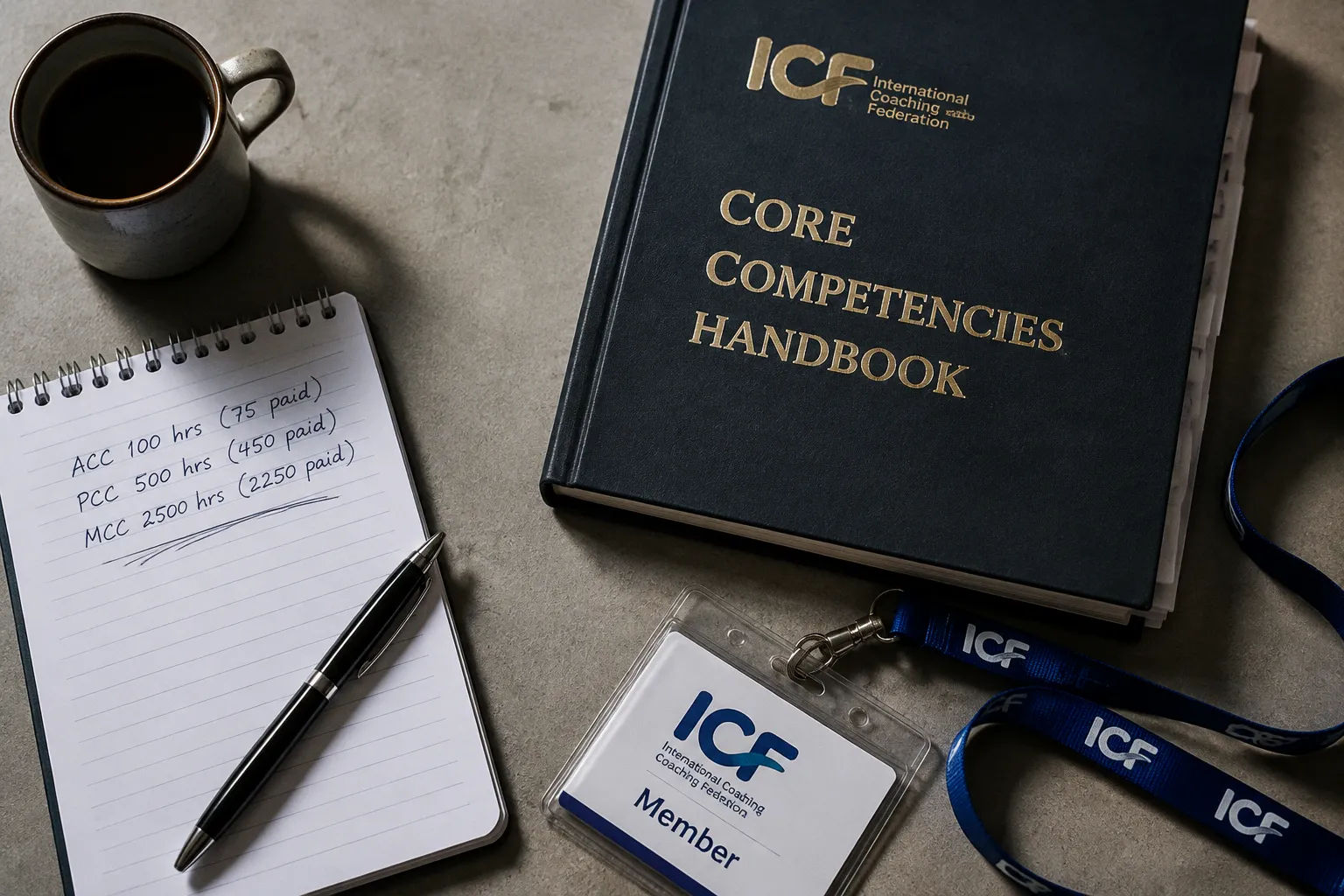
The International Coaching Federation, commonly known as the ICF, is one of the major professional bodies used by clients and organizations when evaluating coaching qualifications. Its credential structure has three levels:
| Credential | Education requirement | Coaching experience | Paid-client experience |
|---|---|---|---|
| ACC — Associate Certified Coach | 60 or more education hours | 100 or more hours | At least 75 paid hours, with experience across 8 or more clients |
| PCC — Professional Certified Coach | 125 or more education hours | 500 or more hours | At least 450 paid hours, with experience across 25 or more clients |
| MCC — Master Certified Coach | 200 or more education hours | 2,500 or more hours | At least 2,250 paid hours |
The hours do not tell you everything. Coaching is not simply a matter of accumulating time in a calendar. Still, the progression gives you a practical way to distinguish an entry-level credential from a designation built on a much deeper record of client work.
The MCC is an unusually advanced credential. Fewer than 4% of ICF members hold it, according to the research provided for this article. That figure is useful not because you need to find an MCC coach, but because it places the designation in context: it represents a relatively rare level of documented experience rather than a routine course completion.
The 2022 ICF Global Consumer Awareness Study found that 85% of coaching clients value credentials. Clients whose coaches held a credential reported 28% higher satisfaction with their coaching experience. These figures do not establish that a credentialed coach will be the right person for you, nor do they turn satisfaction into a clinical outcome. They do show that clients notice the presence of professional standards and tend to experience that structure as meaningful.
When reviewing a coach’s credentials, look for the name of the credentialing organization and the exact designation. A statement such as “internationally accredited” is too indistinct to carry much weight on its own. The useful information is specific: which body issued the credential, what level it is, and whether it can be independently verified through the organization’s directory or records.
Education hours are only one layer of preparation
A coach may have studied positive psychology, somatic coaching, NLP, hypnotherapy, leadership, communication, or another related discipline. Those areas can shape a thoughtful practice, but they are not interchangeable.
For example, a life coach using somatic methods may invite you to notice breath, posture, muscular tension, or the difference between activation and settling. That can be a valuable way to explore decision-making and emotional patterns. It does not, by itself, make the practitioner a licensed healthcare professional or authorize them to diagnose a mental-health condition.
Similarly, training in hypnotherapy may be relevant to subconscious habits and internal imagery, while executive coaching may focus more closely on leadership behavior, delegation, and organizational relationships. The practitioner should describe the boundary between these services rather than allowing every method to blur into one promise of total transformation.
A useful credential review therefore includes two questions at once:
1. What formal training has this person completed?
2. Does that training match the kind of support I am actually seeking?
Course completion is not the same as independent certification
The language around coaching education can create a soft fog. A website may list several certificates, diplomas, badges, and academy affiliations, all presented with the visual confidence of professional accreditation. The details underneath may be quite different.
A course completion certificate generally means that a student finished the requirements set by a particular school. That may involve substantial education and practice. It may also be a short online program with no independent assessment, no mentor supervision, and no documented client-hour requirement.
An independent credential is awarded by a body that applies standards beyond the training school itself. The credentialing organization may review the coach’s education, client hours, mentor coaching, ethics knowledge, and performance in an assessment process.
Neither category needs to be treated with suspicion. The point is to name the category accurately.
Here is the distinction in practical terms:
| What you see | What it usually demonstrates | What it does not automatically demonstrate |
|---|---|---|
| Certificate from a coaching academy | Completion of that academy’s curriculum | Independent assessment or verified professional standing |
| Specialist training certificate | Education in a method or subject area | Broad competence across all life-coaching situations |
| Credential from an independent body | Meeting defined external requirements | Personal compatibility or guaranteed results |
| Years of coaching experience | Time spent working with clients | Ethical practice, appropriate scope, or quality of supervision |
A responsible practitioner should not become defensive when you ask about this difference. They may have excellent reasons for choosing a particular training path, especially if their practice combines coaching with another established profession. What matters is whether they can explain their preparation plainly, without using the word “accredited” as a substitute for detail.
You can also pay attention to the physical quality of the conversation. Do you feel more oriented as the explanation unfolds, or do you feel subtly hurried into admiration? Clarity has a settling effect. It leaves room for your judgment.
How to evaluate life coaching certifications without losing the human element
Credentials are easiest to assess when you place them alongside the coach’s actual method. A designation may confirm that a person has met a professional standard, but it cannot tell you how a session feels, whether the coach listens well, or whether their interpretation of your experience leaves enough room for your own knowing.
During an introductory call, you might ask:
- Which credential do you hold, and which organization issued it?
- How many hours of coaching experience have you completed?
- What kinds of clients do you most often work with?
- How do you define the difference between coaching, therapy, mentoring, consulting, and teaching?
- How do you decide whether a client needs a referral to another professional?
- What happens if I do not agree with your interpretation of a situation?
- How do you usually track progress?
- What does confidentiality mean in your practice, and are there circumstances in which it has limits?
- What is the structure of your sessions, and how much flexibility is there when a client needs to slow down?
- How can I end the coaching arrangement if it no longer feels useful?
The aim is not to conduct an interrogation. These questions help you notice whether the coach can hold both structure and uncertainty. A good coaching relationship has direction, but it should not require you to surrender your discernment.
For clients looking for personal development coaching, the most revealing question may be how the practitioner works with a goal that changes. People often arrive with an outcome that sounds straightforward—leave a job, improve a relationship, become more confident—but discover that the deeper issue involves grief, fear, exhaustion, identity, or an old protective response.
An action-oriented coach does not need to force the original goal forward at all costs. They can help you clarify what has changed, identify the next honest step, and separate a value from a performance demand. That is different from allowing sessions to drift without direction.
Coaching should create agency, not dependence
The central movement in life coaching should be toward greater agency. You may become more aware of your patterns, more able to name your values, and more prepared to make decisions without needing the coach to approve each one.
Be cautious when a practitioner presents themselves as the essential source of your answers, energy, healing, or success. A coach may offer a strong framework and perceptive observations, but the relationship should not be built around the idea that you cannot progress without continued access to them.
This is particularly relevant in somatic or energy-oriented practices. Grounding language can be supportive when it brings attention back to breath, sensation, and the present moment. It becomes less grounded when ordinary uncertainty is framed as proof of hidden forces that only the practitioner can interpret.
The question is simple: does the method help you become more connected to your own experience, or does it make you increasingly dependent on the coach’s explanation of it?
Red flags that appear before the first session
Many problems in coaching selection are visible before any coaching begins. They appear in the sales process, in the promises made on a website, or in the way a practitioner responds to a reasonable question.
Several patterns deserve a slower pace:
1. Guaranteed financial, relationship, or lifestyle results.
No coach can legitimately guarantee a particular career outcome, income level, relationship result, or timeline. Coaching may influence how you act and what you notice, but it does not control markets, other people, institutions, or chance.
2. Pressure to buy a large package immediately.
A coach may offer a structured program, and a longer engagement can be appropriate for some goals. Pressure, countdowns, emotional leverage, or claims that hesitation proves you are resisting change are different matters.
3. A credential described without a named organization.
If a practitioner says they are accredited but does not identify the accrediting or credentialing body, the claim is difficult to evaluate. Specificity should not be considered an unreasonable demand.
4. Personal storytelling replacing methodology.
A coach’s lived experience can help clients feel understood. It should not be the only evidence offered for competence. Your situation is not required to follow the coach’s story.
5. One method presented as an answer to every problem.
A practitioner who uses NLP, hypnotherapy, Reiki, visualization, breathwork, or somatic attention may have a coherent reason for doing so. Be cautious when one approach is presented as universally sufficient, especially for conditions outside the scope of coaching.
6. Dismissal of medical or psychological care.
Coaching should not require you to stop prescribed treatment, avoid a qualified clinician, or reinterpret serious symptoms as a simple failure of mindset.
7. No clear agreement about boundaries.
You should be able to understand the fee, cancellation policy, session format, confidentiality arrangements, and nature of the service before committing.
These signs are not a verdict on the person’s character. They are information about the conditions around the proposed relationship. When the body registers unease, it may be useful to slow down long enough to identify what the unease is responding to rather than overriding it in the name of being open-minded.
The first useful result of a coaching consultation may be realizing that you are allowed to take your time before saying yes.
A transformational life coach selection guide for different goals
The most appropriate credential is not always the highest credential. The better question is whether the practitioner’s preparation and experience fit the complexity of the work.
For example, if your focus is a workplace transition, an executive mentor or coach with experience in organizational settings may understand the practical pressures that shape your choices. If you are working through a relationship pattern, you may want someone whose practice regularly addresses communication, boundaries, attachment-related habits, and values clarification—without presenting themselves as a therapist unless they hold the relevant professional qualification.
If your concern is work-life integration, the coach should be able to discuss both the internal and external parts of the problem. That might include beliefs about achievement, but also workload, role expectations, caregiving, financial constraints, and the capacity of your nervous system to sustain change.
A few matching questions can bring the decision into focus:
- Is the coach experienced with the life stage or context I am navigating?
- Do they understand the practical environment around my goal?
- Is their approach compatible with the way I process information and make decisions?
- Can they work with emotional material without claiming to treat what they are not qualified to treat?
- Do they describe success in terms I can recognize, rather than using a vague promise of becoming a completely different person?
- Does their pace allow for both insight and action?
Credential level and personal fit are separate decisions
An ACC credential may be a reasonable starting point for a practitioner who is building a focused practice and communicates with care. A PCC may bring a broader record of client work, while an MCC reflects a rare level of documented coaching experience. None of these designations tells you whether the coach’s manner will support your nervous system, whether their questions will be useful, or whether their specialty matches your circumstances.
Likewise, the absence of an ICF credential does not automatically make a practitioner incapable of helping. It does mean that you have less external information from that particular credentialing pathway and may need to ask more about education, supervision, client experience, ethics, and scope.
A credential is one layer of evidence. The quality of the relationship is another. The two should be considered together.
What professional ethics look like in ordinary conversation
Ethics can sound abstract until you notice them in the small moments of a consultation. A coach who practices ethically does not need to announce their integrity repeatedly. It appears in how they describe the work.
They can acknowledge that coaching outcomes vary. They do not claim ownership of your decisions. They can explain what information is private and what the limits of confidentiality are. They do not blur coaching with diagnosis or promise to resolve every form of distress.
They also understand consent as an ongoing process. You should be able to decline an exercise, ask what it is intended to support, or say that a particular line of inquiry does not feel appropriate. This is especially important when a session includes body awareness, visualization, touch, hypnosis, energy work, or emotionally evocative material.
A grounded practitioner will not treat discomfort as automatic evidence that the method is working. Sometimes discomfort is part of a meaningful process. Sometimes it is a sign to pause, clarify, or stop. The difference deserves attention.
If you are comparing several coaches, observe whether each one leaves you with a stronger sense of choice. You do not need to feel euphoric after a consultation. A quieter result is often more useful: a clearer understanding of the process, a realistic sense of what it may ask of you, and enough internal space to decide without pressure.
The decision can be practical and embodied
You do not need to choose between a rational review of credentials and an intuitive sense of fit. Both forms of information can belong in the decision.
Start with the external evidence: the credentialing body, education, experience, scope of practice, ethics, fees, and agreement. Then notice the internal response. As you listen to the coach explain their work, does your breathing become more available, or do you find yourself bracing? Do the answers create orientation, or do they leave you trying to decode impressive but empty language?
The body is not an infallible screening instrument. Past experiences can make unfamiliarity feel unsafe, while persuasive confidence can feel reassuring even when the details are thin. But physical response is still data. It can tell you when to ask one more question, request time, or decline an arrangement that does not feel steady.
Before making a decision, you might place both feet on the floor and allow your exhale to lengthen without forcing it. Feel the support beneath you. Name, in simple language, what you know: the credential, the method, the boundaries, the cost, and the part that remains uncertain. Let the decision come from that fuller field rather than from urgency.
The right life coach is not necessarily the person with the most compelling promise or the longest list of modalities. It is someone whose preparation can be understood, whose boundaries are visible, whose method supports your agency, and whose presence allows your own judgment to remain in the room.
That is the foundation beneath any sustainable transformation: not surrendering your discernment, but becoming more able to feel, think, and choose from a grounded place.