Is Relationship Life Coaching Worth the Investment?
The question “is relationship life coaching worth it?” usually arrives when a relationship is still functioning on the surface but no longer feels workable underneath.
Angela Dinsmore·Updated: September 06, 2026·12 min read
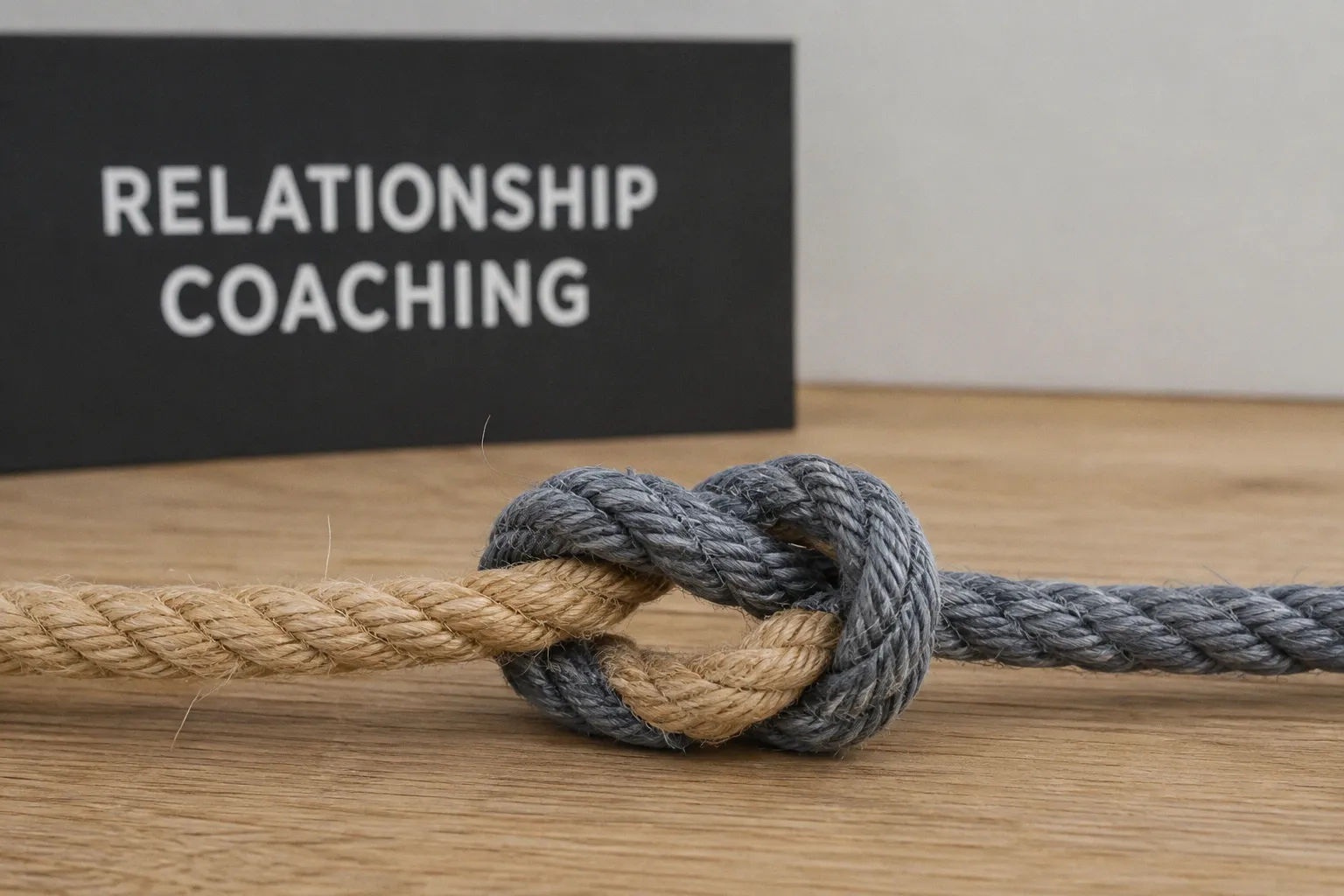
Conversations repeat the same pattern, conflict settles into the body as tension, and even quiet moments carry the anticipation of the next disagreement. You may understand what needs to change and still find that understanding does not translate into different behaviour.
Relationship life coaching can be valuable in that space, but not because a coach offers a guaranteed formula for intimacy. Its value depends on the problem you are bringing, the structure of the work, the willingness of both people to participate, and the coach’s ability to stay within a non-clinical role. The investment is easier to assess when you look beyond the hourly fee and ask what the coaching is designed to change.
The strategic difference: coaching versus clinical therapy
Relationship coaching and couples therapy can look similar from the outside. Both may involve two people in a room, guided conversation, difficult emotions and a desire to stop repeating old patterns. The difference lies in the centre of gravity.
Clinical therapy is generally concerned with mental health, psychological distress, trauma, attachment injuries and the effects of past experiences on present functioning. A licensed marriage and family therapist or another qualified mental-health professional is trained to assess and treat clinical conditions. Therapy may look back because the history of a relationship, family system or nervous system can be essential to understanding what is happening now.
Coaching is usually more forward-facing. It focuses on goals, decisions, communication habits, accountability and the practical movement from the current situation toward a preferred one. A relationship life coach might help you clarify what commitment means to each partner, establish a more useful way to discuss money, or create a process for repairing conflict after it has happened.
That distinction is not a hierarchy. Coaching is not therapy with fewer credentials, and therapy is not coaching delivered more slowly. They answer different questions.
- Therapy may ask: what is driving this distress, and what needs clinical treatment?
- Coaching may ask: what do you want to create next, and which behaviours would move you there?
- Therapy may need to address trauma, depression, addiction, abuse or severe relational instability.
- Coaching may be appropriate when both people can participate voluntarily and are seeking direction, structure or accountability.
A coach should not present relationship coaching as a replacement for licensed therapy or mental-health treatment. If there is coercive control, ongoing abuse, a significant untreated mental-health condition, active addiction or fear of speaking honestly with a partner, the issue is not simply a lack of communication technique. In those situations, a clinical or specialist intervention may be more appropriate.
This boundary also affects the value of the investment. A service can only be effective when it is suited to the problem. Paying for coaching when the relationship requires clinical care does not make coaching a poor service; it means the initial assessment was incomplete.
Relationship coaching is most useful when the relationship has enough safety for both people to choose change, practise it and remain accountable for what happens next.
What relationship coaching actually gives you
The most useful coaching is not an extended conversation about feelings without a direction. It creates a working structure around a relational problem that may otherwise feel too broad to hold.
Many couples arrive with a general complaint: we cannot communicate, we keep arguing, we have lost connection. A coach helps translate that complaint into observable patterns. Perhaps one partner raises an issue indirectly, the other hears criticism and withdraws, and the first partner escalates because withdrawal feels like abandonment. The pattern then becomes the subject of the work, rather than the moral character of either person.
That shift matters. When the focus moves from who is right to what happens between you, there is more room for choice.
A relationship life coach may support you with:
- clarifying shared and individual values;
- identifying the moments when a disagreement changes direction;
- preparing for difficult conversations before they become confrontations;
- developing agreements around time, household responsibilities, intimacy or finances;
- practising listening that does not immediately become defence or counterargument;
- setting goals for emotional closeness and reviewing whether daily behaviour supports them;
- rebuilding trust through consistent, measurable actions rather than reassurance alone;
- making a decision about the next stage of a relationship with less confusion.
This is where the physical experience of a relationship becomes relevant. You may notice your breath becoming shallow when a certain topic appears, your shoulders tightening while your partner is still speaking, or a sudden urge to explain yourself before you have fully heard the other person. These responses are not proof that a partner is unsafe, nor are they something to override through willpower. They are information about the point at which the conversation leaves a reflective state and enters protection.
A grounded coach can help you notice that transition early enough to create a pause. The aim is not to become perfectly calm. It is to build enough space between sensation and reaction for a different response to become possible.
The cost of relationship coaching
Relationship coaching fees vary by qualification, location, format and specialisation. A commonly reported range is approximately $100 to $200 per hour, with specialised practitioners charging up to $350 or more. In the UK, sessions are often listed between £50 and £250 or more per hour.
Packages are also common. A six- to twelve-session programme may cost roughly $500 to $2,500, sometimes including email support, exercises, progress tracking or additional resources. UK packages are often reported in the range of £500 to £800 for six sessions, although the market is not standardised.
| Coaching format | What it may include | What to examine |
|---|---|---|
| Single session | One defined issue, decision or communication challenge | Whether the session is genuinely focused or mainly an invitation to buy a package |
| Short programme | Several sessions over a set period, often with between-session practice | How progress is measured and what happens if the goal changes |
| Six- to twelve-session package | A wider relationship goal, accountability and structured review | Total cost, cancellation terms, support between sessions and the coach’s boundaries |
| Premium or specialised coaching | Expertise in areas such as executive relationships, separation decisions or complex life transitions | Whether the additional fee reflects relevant expertise rather than prestige alone |
The hourly rate tells you only part of the story. A lower fee does not necessarily mean lower value, and a higher fee does not guarantee stronger results. The important question is whether the coach can describe the work clearly.
Before committing, listen for specifics:
- What kind of relationship concerns does the coach work with?
- How is the first session used to establish a goal?
- What happens if one partner wants to continue and the other does not?
- How does the coach recognise when therapy or another specialist service is needed?
- Will you receive practices or decisions to work with between sessions?
- How will you know whether the process is helping?
A professional answer does not need to sound polished or sales-oriented. It should make the container of the work easier to feel: what happens in the session, what remains outside the coach’s role, and how the relationship will be reviewed over time.
Why structure affects outcomes
The strongest argument for relationship coaching is not that conversation alone transforms people. It is that a well-structured process can turn a vague wish for change into a sequence of choices that can be observed and revisited.
Two frameworks often used in coaching are GROW and CLEAR.
GROW moves through Goal, Reality, Options and Will. In relationship work, that might mean defining the desired change, describing what currently happens without softening it, considering possible responses, and deciding what each person is prepared to do next.
CLEAR places more emphasis on the coaching relationship and review process: Contracting, Listening, Exploring, Action and Review. This can be useful when the presenting issue changes as the couple gains a more accurate understanding of the pattern.
Neither framework is a magic mechanism. Their value is in preventing the work from becoming an endless circulation of insight without application.
A practical coaching conversation might develop in this order:
1. Name the pattern precisely.
Instead of “we always fight,” identify the sequence: one person asks for reassurance, the other becomes analytical, the first person raises the emotional intensity, and both leave feeling unheard.
2. Define the outcome in behaviour.
“Better communication” is too vague to guide practice. A more useful goal might be being able to discuss a sensitive topic for fifteen minutes without interruption, threats or withdrawal.
3. Separate intention from impact.
A partner may intend to give space while the other experiences abandonment. Coaching can hold both realities without deciding that one person’s intention cancels the other person’s experience.
4. Choose a small experiment.
The couple might agree to use a pause phrase, reflect back what was heard before responding, or schedule a conversation rather than beginning it during exhaustion.
5. Review what happened.
If the experiment failed, that is not automatically evidence that the relationship cannot change. It may show that the agreement was too broad, the timing was poor or one person did not feel safe enough to participate.
This is where accountability becomes different from blame. Accountability asks what happened, what each person contributed and what can be adjusted. Blame reduces the entire event to a verdict about character.
Calculating the return on investment
The return from relationship coaching is partly emotional and partly practical, which makes it difficult to express in a single number. A relationship may become more connected, but it may also become clearer. Sometimes the valuable outcome is not staying together at any cost; it is making a decision without months or years of circular conflict.
Research and industry reporting on broader coaching programmes have described high satisfaction and measurable improvements in personal well-being when structured methods are used. A frequently cited PwC and coaching-industry estimate reports an average return of seven times the cost of hiring a coach, but that figure should not be treated as a personal guarantee or as a relationship-specific outcome. It is better understood as an indication that coaching can produce value beyond the immediate session when the goals are concrete and the changes are carried into daily life.
For relationship coaching, potential returns may include:
- fewer repetitive arguments and less time spent recovering from them;
- earlier, clearer conversations about decisions that would otherwise become crises;
- stronger boundaries around work, family, privacy and emotional availability;
- greater confidence in expressing a need without turning it into an accusation;
- improved ability to repair after conflict;
- clarity about whether both partners are willing to invest in the relationship;
- reduced emotional exhaustion from trying the same unstructured solutions repeatedly.
There is also an opportunity cost. If six months of conflict avoidance leads to a major rupture, the eventual emotional, financial and logistical consequences may be considerably larger than the cost of earlier guidance. That does not mean every relationship problem should be outsourced to a professional. It means timing has a value of its own.
At the same time, coaching cannot manufacture mutual commitment. If one person attends only to prove that the other is the problem, the process will likely become another stage for the existing dynamic. If both partners are willing to examine their part, practise new behaviours and tolerate some discomfort, the likelihood of meaningful progress is stronger. Some relationship coaching studies have reported positive change in around 75% of relationships under conditions of appropriate structure and mutual commitment, but that figure should not be read as a universal success rate across all coaches, couples or situations.
The expected outcomes are therefore best framed as possibilities rather than promises. You might gain closeness. You might gain a more functional way to disagree. You might gain the clarity to stop negotiating against your own values. All three can be worthwhile, although they are not interchangeable.
Choosing a coach without confusing confidence with competence
Relationship coaches are not generally required by state law to hold the same clinical licences or mental-health master’s degrees as marriage and family therapists. The field includes practitioners with substantial training, clear ethical boundaries and focused experience, as well as people who use broad claims without a reliable method.
Accreditation can be useful, but it is not the only question. Look for alignment between the coach’s training and the work you need. A coach whose practice centres on personal development may be helpful with values clarification or goal setting, while a practitioner focused on relationship communication may be more suitable for recurring conflict. Executive mentoring, emotional resilience coaching and work-life integration can overlap with relationship concerns, but they do not automatically prepare someone for couples work.
A useful first conversation should leave you with more discernment, not more pressure. Notice whether the coach:
- describes coaching as forward-looking rather than as a substitute for therapy;
- explains confidentiality and what happens when two partners are involved;
- asks about safety, consent and the nature of the conflict;
- can name situations outside their scope;
- offers a process for setting and reviewing goals;
- avoids promising guaranteed healing, permanent harmony or a fixed result;
- allows you to consider the fit without creating urgency around payment.
A coach does not need to be emotionally distant to be professional. Warmth can help the body settle enough for honest reflection. But warmth should sit alongside precision. You should be able to understand what you are paying for, what participation requires and what evidence of movement might look like.
So, is relationship life coaching worth it?
Relationship life coaching is worth the investment when the problem is suitable for coaching, the work has a defined structure and the people involved are willing to translate insight into repeated action. It can be especially useful when you are not in immediate clinical danger but are caught in a pattern that neither conversation nor good intentions has shifted.
It is less likely to help when one person is being coerced into attending, when serious mental-health or safety concerns are untreated, or when the coach presents certainty where the situation requires careful assessment.
Before your next difficult conversation, take one minute to feel where your body is making contact with the chair or floor. Let the exhale lengthen without forcing it. Notice the pressure in your jaw, chest or hands, and name the sensation plainly: tightness, heat, pulling, numbness. Then ask yourself one grounded question: what would a useful next step look like, not an ideal outcome?
That question brings the work back to the place where change becomes real—not in a promise about the future, but in the next conversation, boundary or act of repair you are actually prepared to make.